
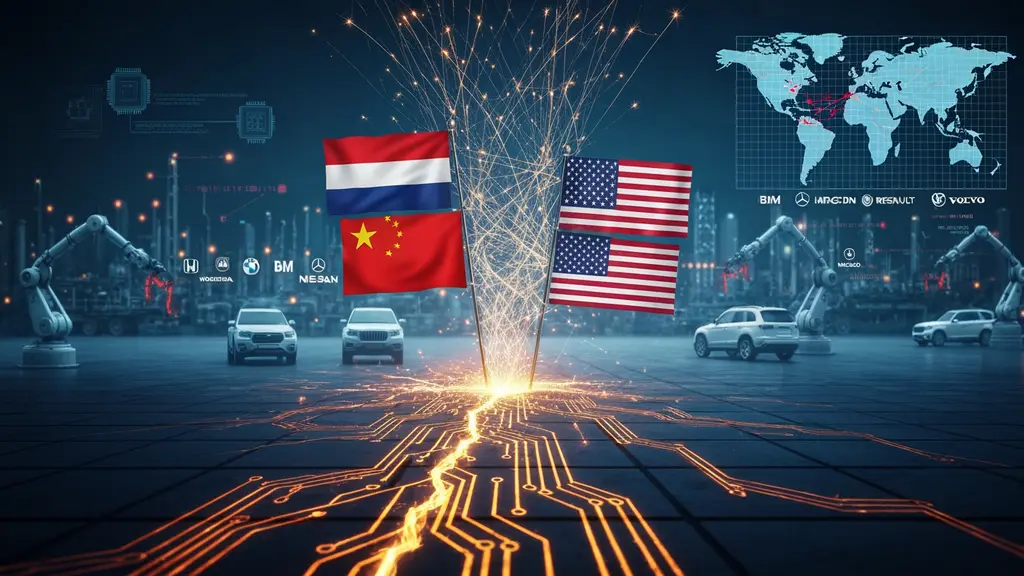
Catenaa, Saturday, November 15, 2025-A dispute over Dutch chipmaker Nexperia has disrupted global auto manufacturing, though partial resolutions suggest supply may stabilize soon.
The Dutch government took control of Nexperia in October, citing national security concerns after identifying governance issues at the Chinese-owned firm.
Nexperia, which makes discrete semiconductors used in adaptive headlights, EV battery management, and anti-lock brakes, faced a boardroom battle resulting in the ouster of CEO Zhang Xuezheng.
The move followed US export restrictions on parent company Wingtech Technology and its subsidiaries, part of broader Washington-Beijing tech tensions.
China initially blocked exports from Nexperia’s Dongguan assembly plant, affecting automakers worldwide. Honda halted production at its Mexican plant making HR-V crossovers, while General Motors, Mercedes-Benz, Nissan, BMW, Renault, Volkswagen, and Volvo warned of potential assembly line stoppages.
Companies scrambled to secure alternative chip supplies and tapped existing stockpiles.
Signs of easing emerged after high-level US-China talks and diplomatic consultations. China’s Commerce Ministry confirmed steps to simplify Nexperia exports to the EU and global clients.
Nexperia’s shipments to Honda have resumed, with production expected to restart the week of Nov. 21 at the Celaya, Mexico plant, capable of 200,000 vehicles annually.
Analysts warned that Nexperia accounts for roughly 5% of automotive discrete chip revenue but a much larger share by volume, underscoring the risk to the global auto supply chain if disruptions persist.
The incident highlights vulnerabilities in semiconductor sourcing and the wider geopolitical friction between the US, China, and Europe over critical technology.