
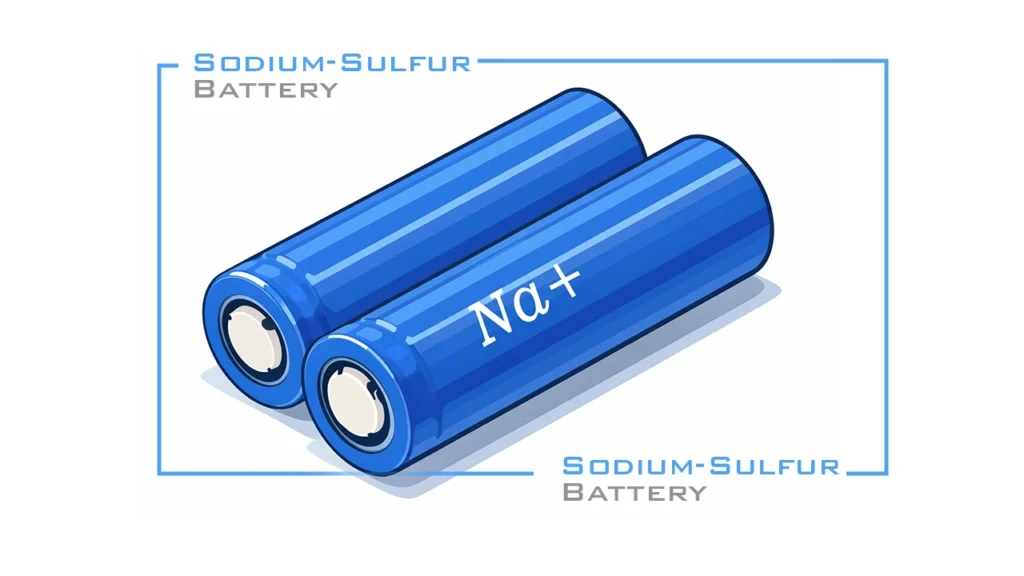
Catenaa, Saturday, January 17, 2026-Scientists at Shanghai Jiao Tong University have designed a new sodium-sulfur battery that offers higher energy and power density while reducing costs and safety risks compared with lithium-ion batteries.
The breakthrough uses S0/S4+ redox chemistry and a non-flammable chloroaluminate electrolyte to create an anode-free, high-voltage design.
The battery features an aluminum foil anode current collector, an S8 cathode, and sodium dicyanamide (NaDCA) in the electrolyte, separated by glass fiber.
This configuration improves the reversibility of sodium plating and stripping while enabling efficient S/SCl4 chemistry at the cathode.
Performance tests show a maximum energy density of 1,198 Wh/kg, a discharge capacity of 715 mAh/g, and a power density of 23,773 W/kg. Adding a Bi-COF catalyst raised the energy density to 2,021 Wh/kg and the discharge capacity to 1,206 mAh/g.
The design offers significant cost advantages, estimated at $5.03 per kWh, roughly one-tenth of comparable lithium-ion batteries.
Safety is enhanced through the non-flammable electrolyte. However, challenges remain: the electrolyte is highly corrosive, short-term air stability is limited, and long-term durability is untested. Researchers are optimistic these issues can be addressed, enabling applications across wearables, grid storage, and other devices.
The findings, published in Nature, highlight the potential of sodium-sulfur batteries as a safer, lower-cost alternative for high-performance energy storage.