
Catenaa, Saturday, January 31, 2026- A silicon photonics startup backed by Bill Gates says it has developed optical transistors thousands of times smaller than current technology, enabling an AI chip that could sharply boost computing performance while keeping power use in check.
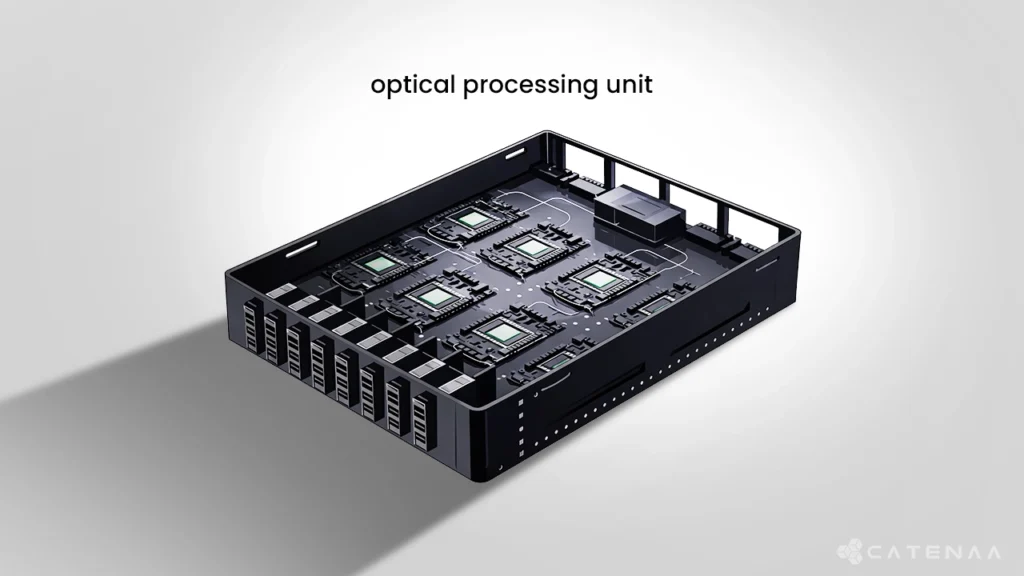
Austin-based Neurophos said its newly developed optical processing unit can handle 1,000 by 1,000 multiplication matrices on a single photonic sensor.
The company claims the design delivers roughly 10 times the performance of Nvidia’s latest Vera Rubin NVL72 system for low-precision AI workloads, with similar energy consumption.
The approach centers on shrinking optical transistors by about 10,000 times compared with components commonly produced by existing silicon photonics factories. Current optical transistors are too large to support dense computing, limiting their ability to compete with conventional digital chips, according to the company.
Neurophos said its first-generation accelerator, called the Tulkas T100, contains the optical equivalent of one tensor core on a die measuring about 25 square millimeters. While that is far fewer cores than leading AI processors, the company argues its much larger matrix size and higher operating frequency offset the difference.
The Tulkas T100 is designed to run at 56 gigahertz, far exceeding clock speeds typical of modern CPUs and GPUs. The higher frequency, combined with photonic processing, is intended to accelerate matrix math central to artificial intelligence workloads.
The startup is backed by the Gates Frontier Fund and is positioning its technology as a potential alternative for AI data centers facing rising power and scaling constraints as demand for compute continues to grow.